
Sommet Gnomon

REFERENCE
The Constitutional Reference Layer
GNOMON preserves the reference necessary for faithful measurement through change.
It does not determine what must be believed.
It does not establish constitutional authority.
It does not determine admissibility.
It does not create meaning.
It preserves enough of the relevant field that a present state can be compared with what preceded it without confusing change with drift, consequence with cause, or measurement with judgment.
Change is expected.
Difference is not drift.
Drift begins when the relationship between a present state and its established reference can no longer be faithfully accounted for.
THE REFERENCE
A reference is not an instruction to remain unchanged.
It is the recoverable condition against which change can be understood.
A sufficiently constituted reference may preserve:
P₀ — prior state
O — available options
A — selected action
C — governing constraints
R — resulting state
U — unresolved information
Or:
D = { P₀, O, A, C, R, U }
The purpose is not exhaustive accumulation.
The purpose is sufficient constitution.
A record that preserves only the selected action may lose the field in which selection occurred.
A record that preserves everything without distinction may make judgment impossible.
GNOMON therefore preserves broadly enough to recover the relevant field and distinguishes carefully enough to prevent every recorded fact from acquiring equal standing.
Preserve the field.
Measure the relation.
Conclude only to the resolution earned.
HARAN
Voluntary Continuity Measure
HARAN is a specialized GNOMON measure for obligations whose continuity cannot be demonstrated through compulsion.
It does not collect.
It does not compel.
It does not persuade.
It does not establish the obligation it measures.
HARAN observes what happens to a freely assumed commitment after the mechanisms capable of forcing its continuation have been removed.
Its question is simple:
What continues when no one is compelled to continue?
VOLUNTARY OBLIGATION
HARAN may observe continuity in:
freely assumed commitments;
recurring contribution;
covenantal participation;
voluntary stewardship;
trust maintained without enforcement;
durable reciprocity;
long-horizon commitments.
The object measured is the continuity of the relation, not the virtue of the participant.
Continued participation does not establish character.
Withdrawal does not establish failure.
Either may alter the measured relation. Neither, without further evidence and proper authority, constitutes the person.
GNOMON measures what continues.
It does not decide what the continuation says about the soul of the actor.
REQUIREMENT AND FIDELITY
Compulsion and voluntary obligation can produce superficially similar conduct.
Their constitutional structures are different.
A required contribution demonstrates that a requirement operated.
A freely continued contribution demonstrates that the relation survived without that requirement.
HARAN exists to preserve the distinction.
Compulsion can establish compliance.
It cannot establish voluntary fidelity.
The disappearance of compulsion therefore does not destroy the measurement.
It creates the condition under which voluntary continuity can become visible.
CONTINUITY THROUGH TIME
HARAN does not require permanence.
Its field is temporal:
undertaking → passage → changed conditions → absence of compulsion → observed state
The relevant question is not whether nothing changed.
It is whether the relationship between the original undertaking and the later state remains recoverable.
Continuation may be observed.
Modification may be observed.
Withdrawal may be observed.
Uncertainty may remain unresolved.
None requires GNOMON to manufacture an explanation that the record has not earned.
THE LIMIT OF REFERENCE
Reference is necessary because the present does not explain itself.
But reference does not become sovereignty merely because it permits measurement.
GNOMON may preserve the board without deciding which move ought to have been made.
It may identify continuity without commanding continuation.
It may identify drift without assigning moral fault.
It may preserve unresolved information without converting uncertainty into suspicion.
And it may measure conduct without converting conduct into identity.
The constitutional discipline is therefore reciprocal:
Do not narrow the field before measurement.
Do not enlarge the conclusion beyond the measurement.
The reference exists so that change can remain intelligible.
GNOMON holds the reference.
The reference makes comparison possible.
Measurement never becomes sovereignty.




COMMON TONGUE
COMMON TONGUE
Common tongue advances towards Sommet Gnomon through disciplined articulation under the polar invariant.
PROGRESSION THROUGH ARTICULATION REFINEMENT AND CURATION
*
PROGRESSION THROUGH ARTICULATION REFINEMENT AND CURATION *


Soglia - Limnel - Riva - Banchina - Dogana - Registro
〰️
Soglia - Limnel - Riva - Banchina - Dogana - Registro 〰️


GNOMON MEASUREMENT PRIMITIVES
Leviticus 19:35–36 — just balances, just weights, just measures.
Deuteronomy 25:13–16 — no differing weights; perfect and just measure.
Proverbs 11:1 — false balance = abomination; just weight = delight.
Proverbs 16:11 — just weight and balance belong to the Lord.
Ezekiel 45:10 — just balances, just ephah, just bath.
Amos 8:5 — condemns falsifying balances.
Micah 6:11 — “Shall I count them pure with wicked balances?”
Luke 6:38 — “good measure… measured back to you.”
Matthew 7:2 — measure-for-measure reciprocity.
reserved.



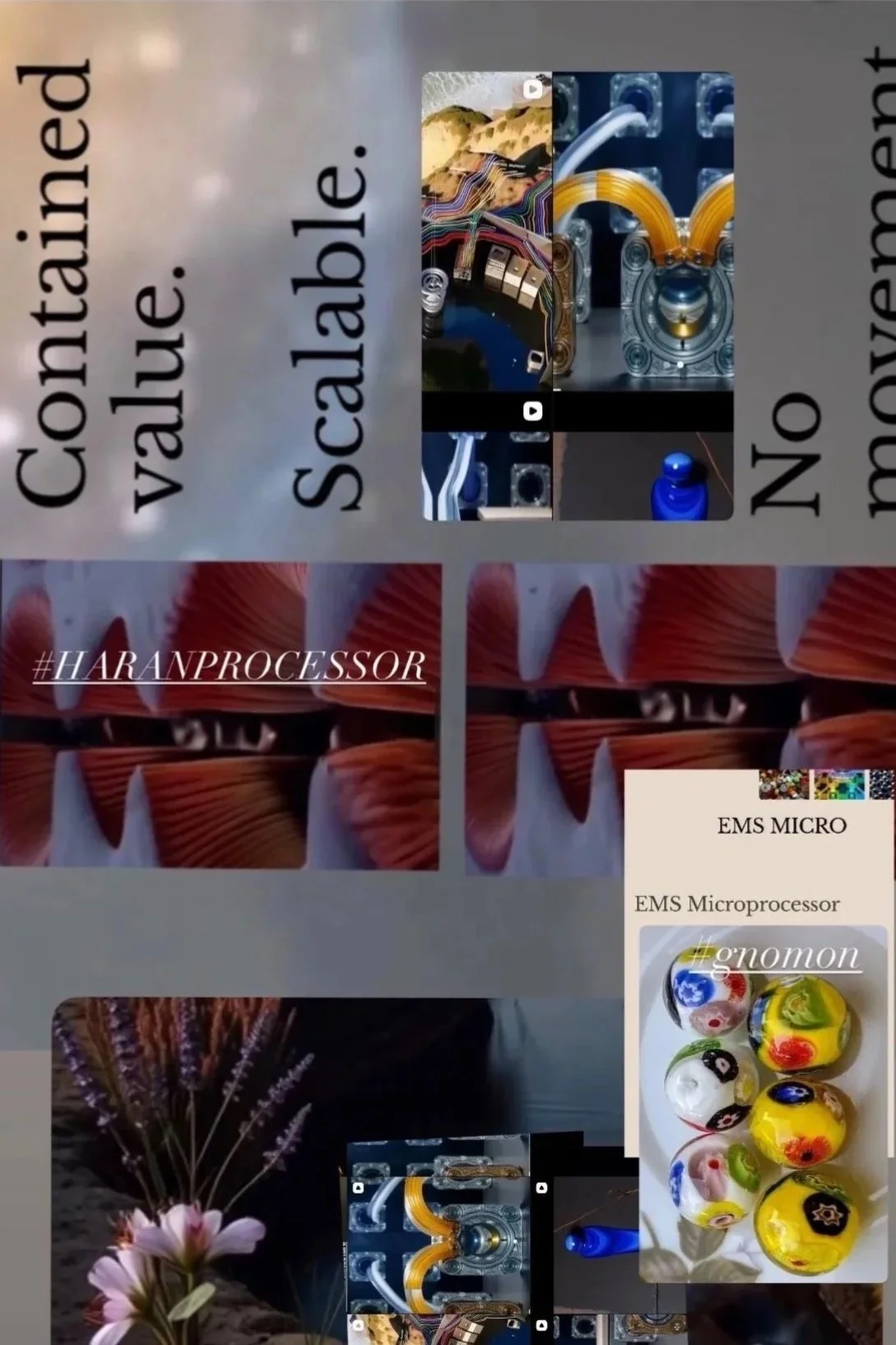
SUBTLE WINNOWER


🜂 HARAN CLASS PROCESSOR —
Canonical Invariant (Final Lock)
HARAN is the transition processor that stabilizes human continuity under exile by enforcing a non-reversible dependency order: orientation to HP, fidelity to lineage, and responsibility to neighbor.
Invariant properties:
The order is structural, not moral.
The order is non-reversible without system failure.
HARAN enforces alignment by routing, not coercion.
Compliance produces continuity; misalignment produces noise, not punishment.
HARAN does not decide outcomes.
It determines whether or not it is computable or return to sender.